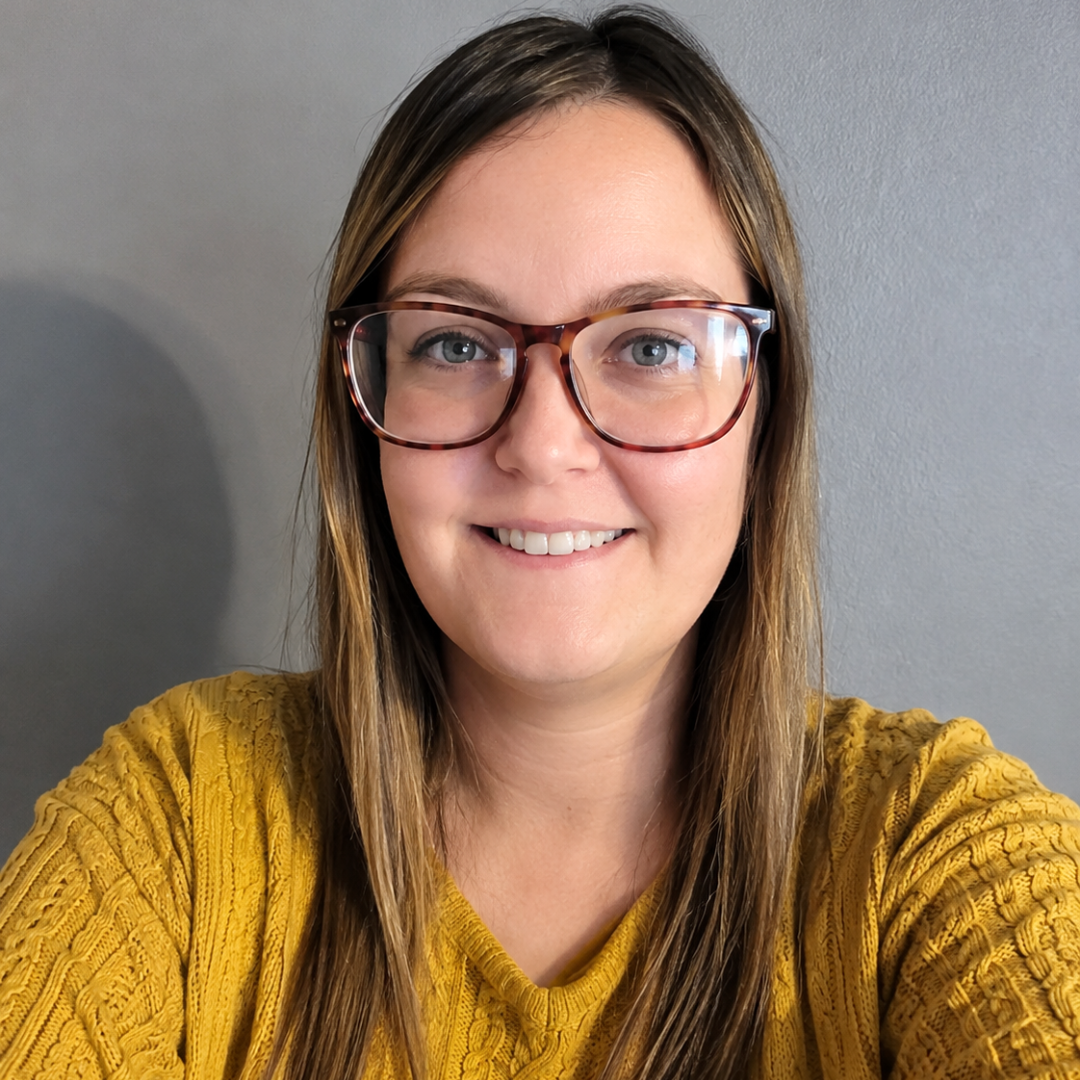
Meet Gillian, AIP warrior
"Pancreatitis and COVID 19 were my initial diagnoses, but it was clear something else was hanging onto me that I just couldn’t shake."
-Gillian, AIP patient.
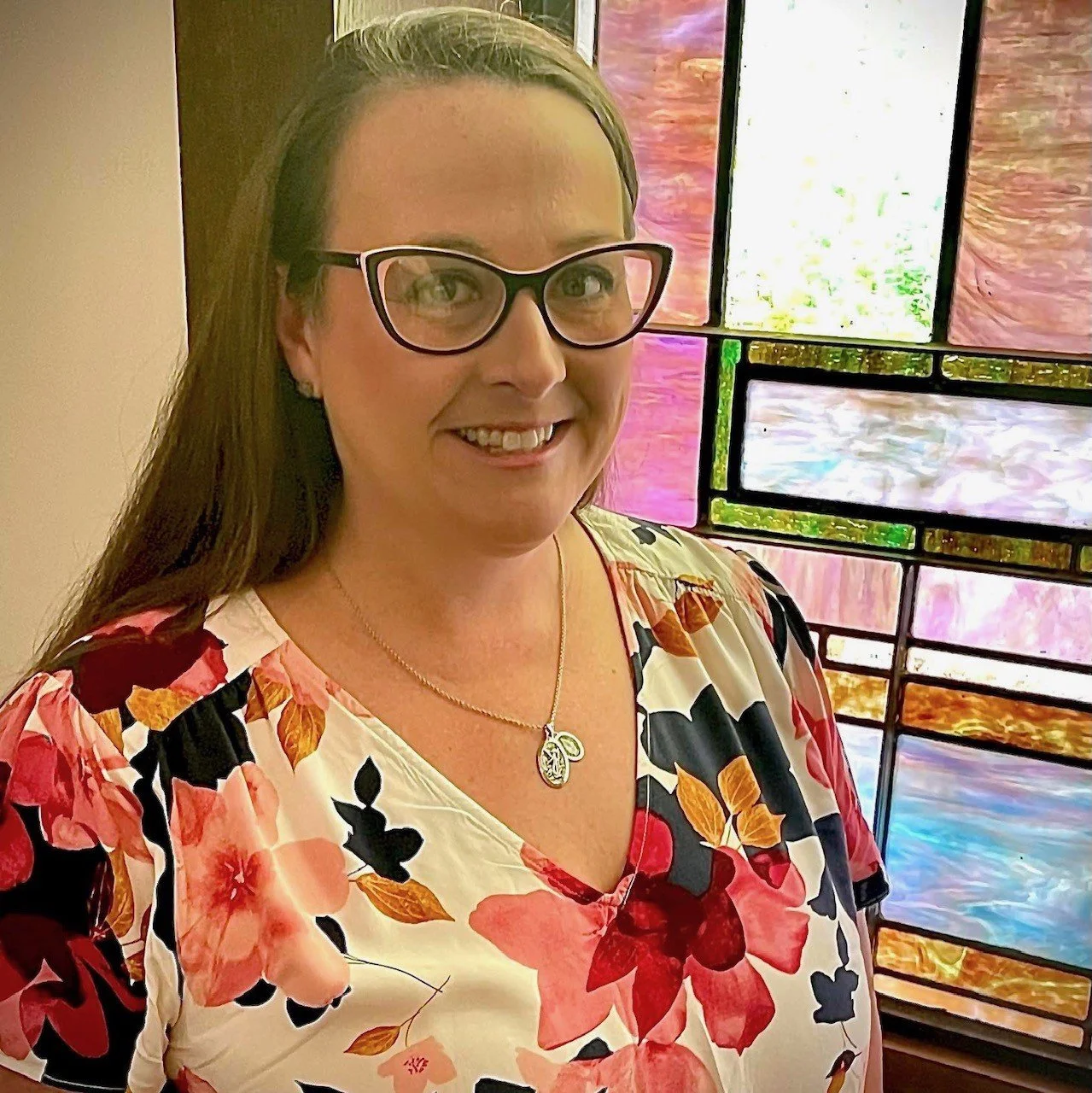
I’m Gillian Brickey. My first name is pronounced with a soft G like giraffe, though I’m short and squat and nothing like one. My husband Justin and I have four sons and a daughter in-love.
Looking back I can see that acute intermittent porphyria (AIP) has been part of my life for a long time, but I wasn’t diagnosed until my mid-forties when a round of COVID 19 fully unmasked its fury. Christmas of 2023, I was forty-five years old, and as my husband and sons recovered from the dreaded virus, I worsened. Pancreatitis and COVID 19 were my initial diagnoses, but it was clear something else was hanging onto me that I just couldn’t shake. Days turned into weeks then months in bed. As I began to sort of recover in March 2024, another wave hit me in April.
“I’d lost thirty pounds in three months, and the gut pain and nausea were still relentless. His response? ‘Sometimes it just takes time for your gut to get back online after a major illness.’”
-Gillian, AIP patient.
FIRST GI: “Normal” is Not Good News
I also have autoimmune diseases, including celiac, and as gut trouble was my loudest complaint, my rheumatologist sent me to a gastroenterologist. After doing preliminary scopes and biopsies the GI said, “Good news! Everything is NORMAL.” In other words: no answers. The gastroenterologist squirmed uncomfortably as I cried, explaining I still couldn’t eat. I’d lost thirty pounds in three months, and the gut pain and nausea were still relentless. His response? “Sometimes it just takes time for your gut to get back online after a major illness.” The major illness was in December, and this was April with symptoms as intense as the first day they began, but there would be no more testing. He was done.
His clinical notes said anxiety was likely perpetuating my symptoms.
Anxiety was a symptom, not a diagnosis.
As I began to doubt myself and the severity of my symptoms, my husband, family, and friends all validated my concerns, which was a great gift. But just as important, my family doctor and rheumatologist, two people who still held keys to more options, also believed something was wrong. My family doctor set up a referral to a second GI at a fancy university hospital system an hour and a half from home.
THE PRAYER: REVEAL THEN HEAL
As I was increasingly visiting urgent care, the emergency room, and doctors’ offices, my husband and I realized they took me more seriously when Justin was there to back me up. He then made it a priority to be by my side at appointments.
Initially our prayer together was for God to heal me. But as time marched on with little change, I couldn’t help but remember when my mom faced years of debilitating symptoms without answers back when I was in high school and college. Not knowing what was wrong with her was as challenging as the illness itself.
“Lord,” I prayed, “I can’t do this without answers. Please REVEAL it and then heal it!” Our prayer was also for a strong, clear diagnosis.
SECOND GI
By the time I saw the second gastroenterologist I’d lost a grand total of fifty pounds. June-August of 2024, the next GI at the fancy hospital ran some additional tests. He found some mild inflammation which he attributed to eating gluten and a progression of my celiac disease.
I assured him I could barely eat anything, much less gluten. None the less, I scoured my kitchen and meds for possible hidden sources. I even had my pharmacist check my meds. I told my new GI I could not find a source of gluten. Short answers on the patient portal stayed limited to celiac progression, and no, it’s not enough to be refractory celiac. I even asked if the findings would account for severe abdominal pain, loss of appetite, and nausea, and he said no. He suspected IBS was to blame.
Another door closed. Dead end.
As I grew sicker with no answers, the losses began to mount. I quit my beloved part-time job at my church and withdrew from most commitments. I had to miss a mandatory staff retreat in Europe for our organization. “Too sick to travel,” said my first rheumatologist. I’d coordinated part of the event. I had two teams of volunteers under me. I gave them as much support and information as I could via emails and Zoom before the retreat, and I stayed home while my family and organization congregated in Europe without me.
Aside from fixing simple meals and some light housework, I was in bed or on the couch the whole time my family was gone. My friends dropped by with flowers and healthy gluten free snacks.
“This is NOT IBS. This is NOT ANXIETY,” I repeated to myself and whomever would listen.
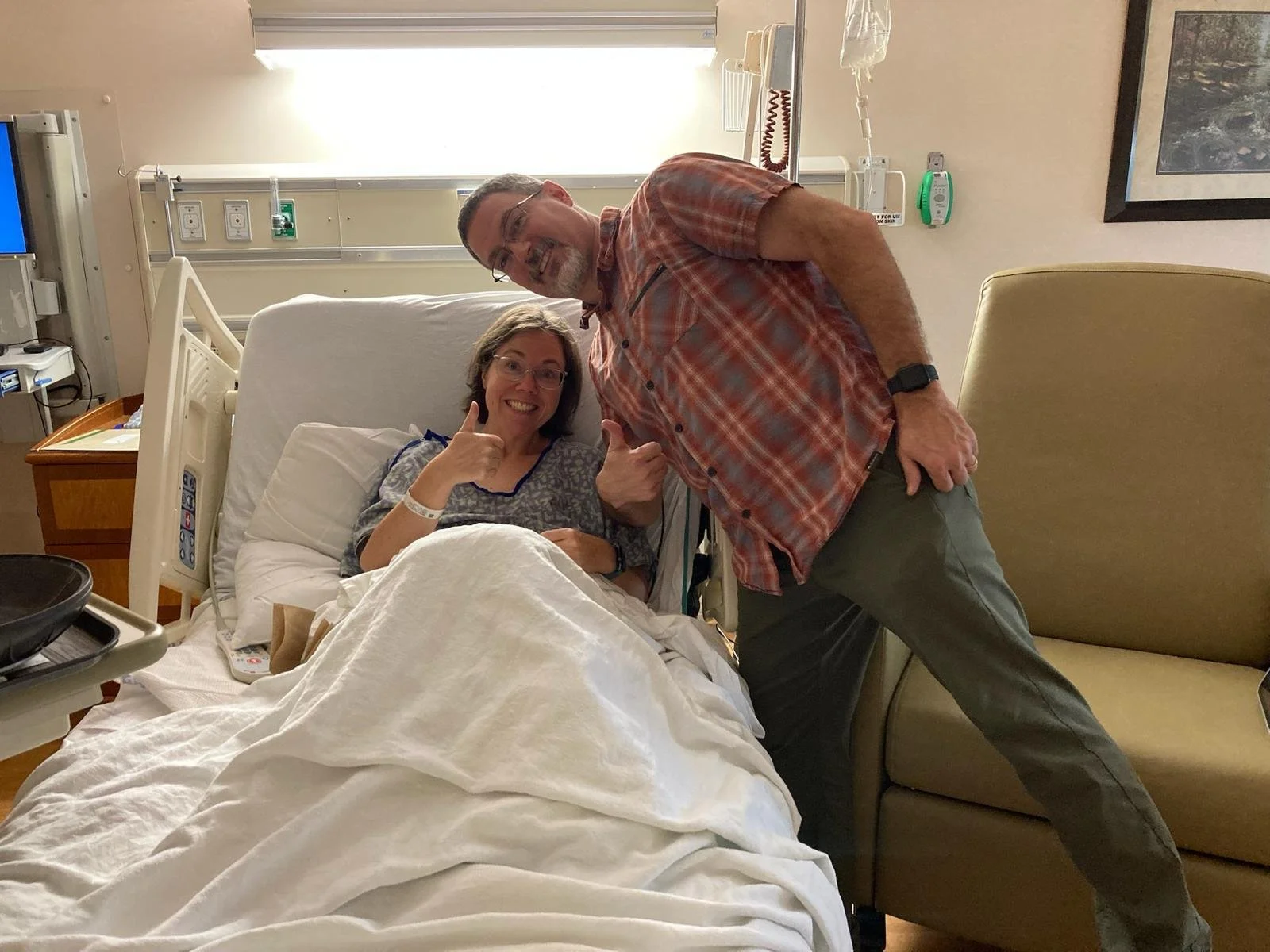
Gillian and her husband.
THE SPECIALISTS
I had a growing list of medical specialists. Gynecologist because I was sickest during my cycle, immunologist, integrative medicine, cardiologist, and more. Each one brought a new diagnosis and another level of feeling better, but none of them pinpointed THE major issue.
My cardiologist diagnosed orthostatic hypotension and occasional PVCs, but everything else was all clear.
Her: How much water do you drink a day?
Me: A minimum of two liters, plus whatever else I drink.
Her: Can you make it three?
Me: Sure.
The cardio symptoms didn’t improve till the porphyria was solved.
By this time I recognized that, though I felt terrible ALL the time, there was a pattern of worse symptoms when I was too sick to leave my bed for about a week every month with my cycle.
It’s common for people with acute porphyria to get an organ or two removed on the path to diagnosis. I ended up with a hysterectomy, and the surgery landed me in the hospital for days with abdominal pain, weakness, and nausea.
THIRD GI – It’s NOT IBS or Anxiety!
My gyn asked for a gastroenterology consult after the hysterectomy, and we met my third GI doctor. He checked my gluten compliance and a slew of other gut diseases. All were normal. Expecting to hear the same IBS or anxiety theory, we were surprised when he said, “I’m not sure what this is, but it’s not IBS.” He also prepared us by saying it would take time to heal from the hysterectomy to figure out if anything more was needed. Track symptoms, look for patterns, and follow up in five months.
Unfortunately, over the next few months, the nurses at his office had to deal with my millions of panicked patient portal questions as my condition worsened.
Understand the issue: On my worst days, my husband would take me to the emergency room. They were usually compassionate and gave me support meds, but with “normal” labs and CT scans, they lacked grounds to admit me and would send me home. Worse, my GI appointments with the nurse practitioner would be scheduled weeks out, never during the attack when I desperately needed help. I peppered the patient portal with messages and left voicemails, but the answer was always: make an appointment. Sigh.
THE BEGINNING OF KNOWING
I finally had the defining follow up appointment with my third GI in April of 2025, a year and a half after the onset of relentless symptoms. I was still brain foggy from an attack, and my gut was still painful.
Third GI came in the room and asked, “Have you heard of porphyria?” We hadn’t. It was the first time anyone brought something to the table that I hadn’t seen or heard during my hours of scouring the internet.
We work internationally, though. What kind of exotic thing did we bring back?
“No, it’s not something you’d catch. It’s hereditary.”
And then he said, “It’s time to quit looking for horses and start looking for zebras. You’ve got a lot going on, and you’re piling up specialists, so let’s look at some things. I’m going to order a bunch of tests, so don’t panic. I think we’ll mostly rule things out.”
It was a fast appointment, but it accomplished everything we needed.
He validated that what I’m facing is real and concerning.
He admitted he didn’t know what this was, and he couldn’t make promises.
He was willing to look outside his specialty and make a good effort to find a solution.
By the end of this appointment, I was confident that if he didn’t find it, it couldn’t be found, and I would accept that IBS was my diagnosis. It’s a diagnosis of exclusion, after all.
Lord, please reveal it then heal it.
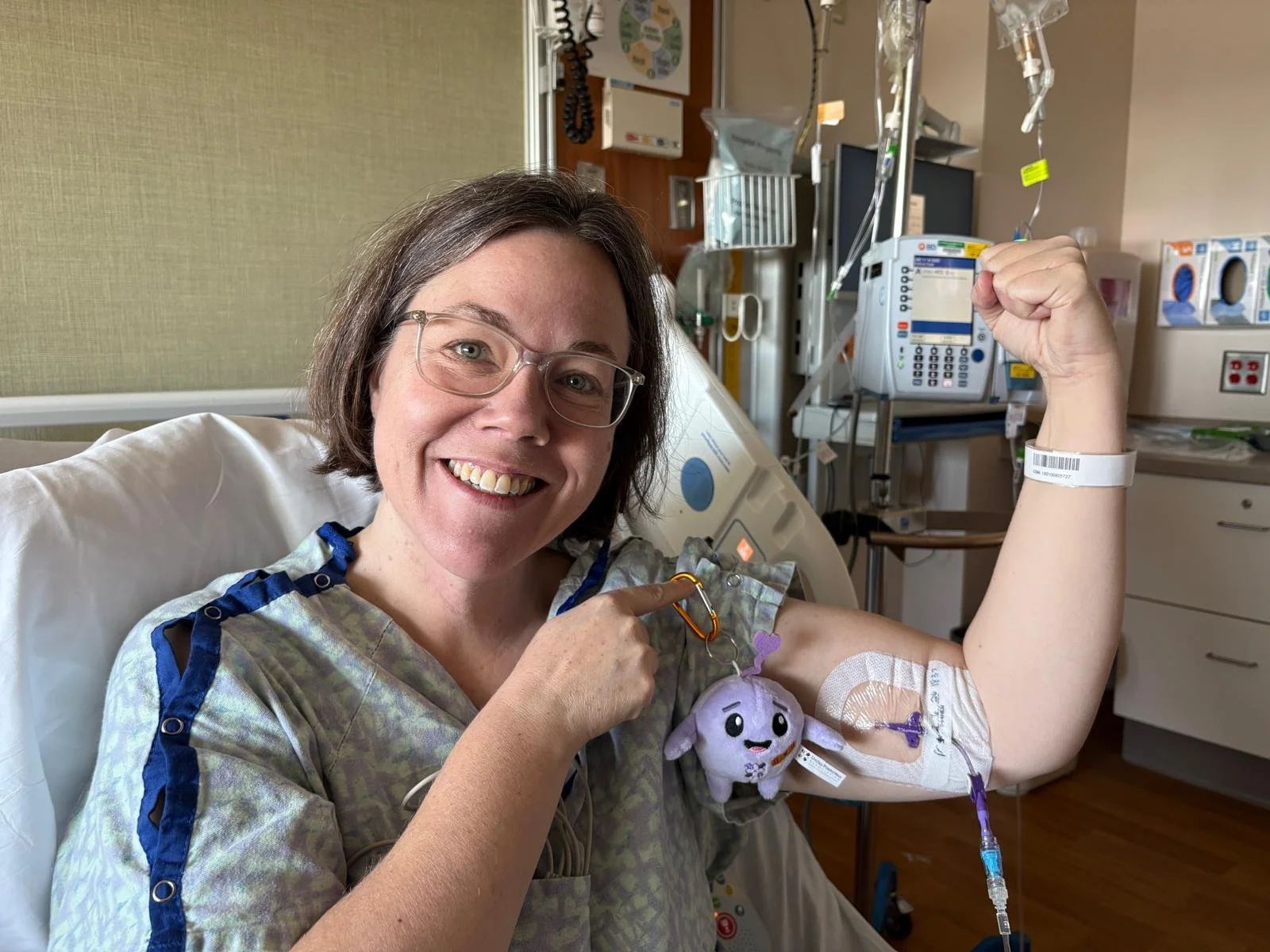
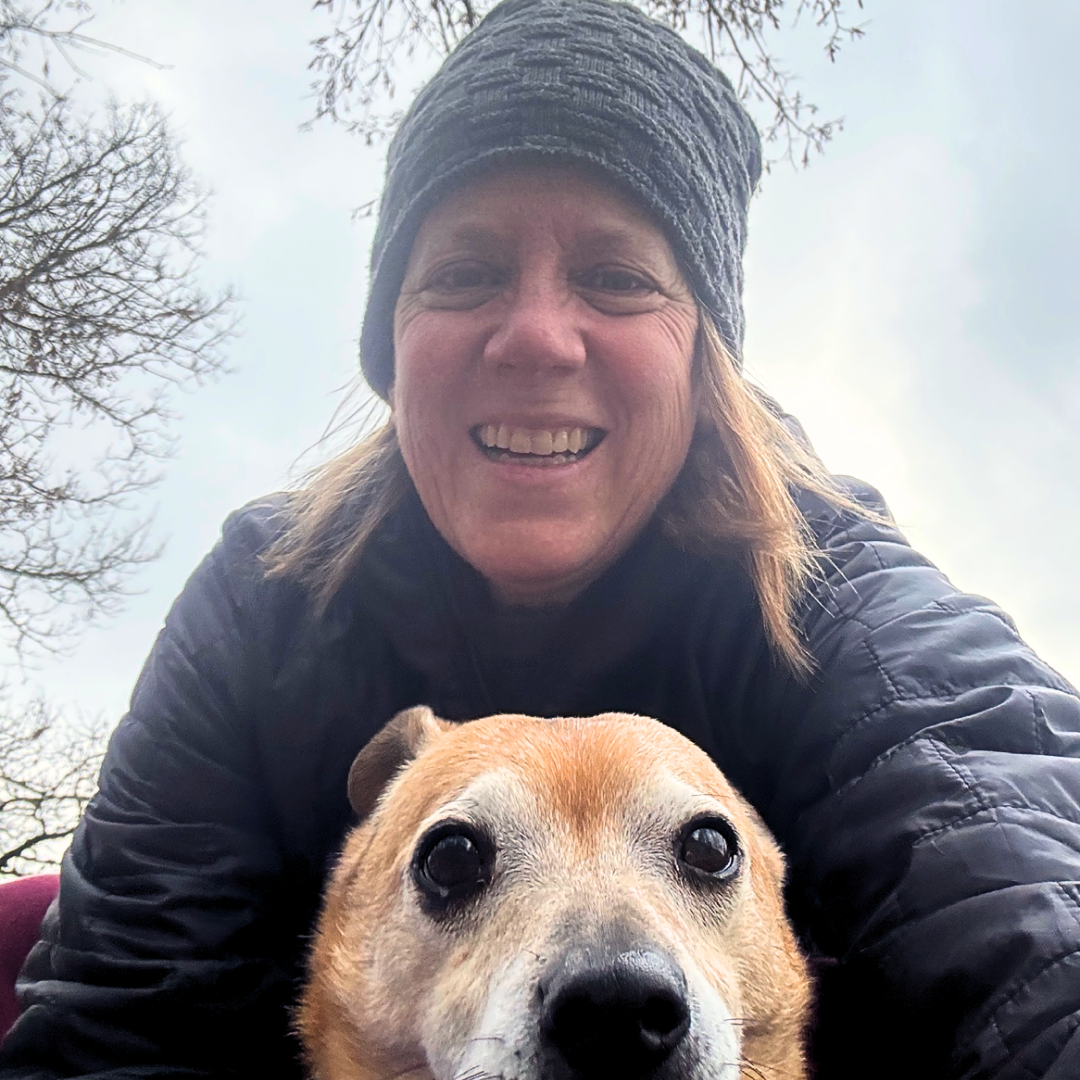
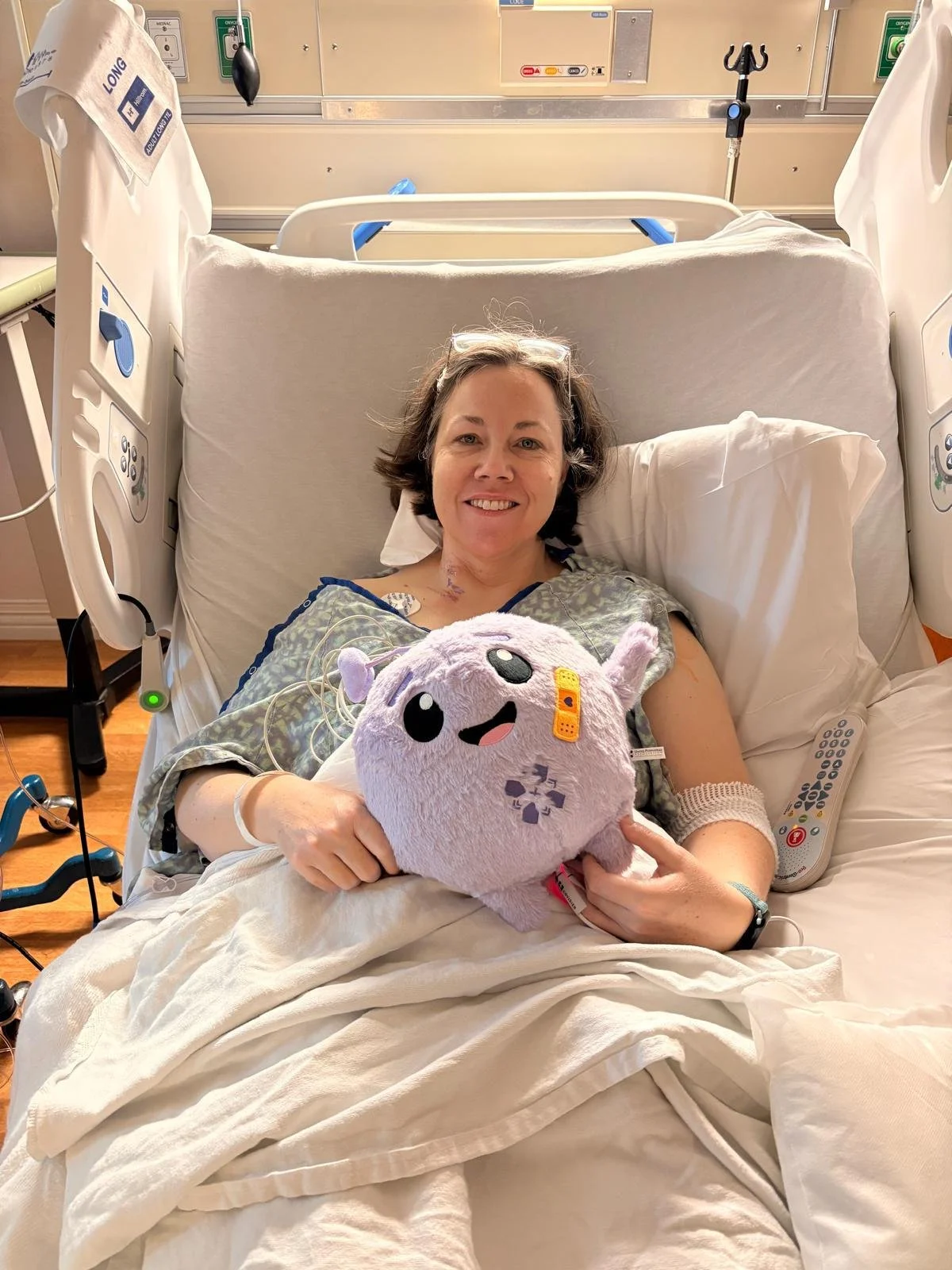
Gillian with Porphy, UPA’s mascot.
THE DIAGNOSIS
While we waited for all the lab results, I was also eating almost zero carbohydrates. By this time, three different doctors suggested I do the carnivore diet for a month, a zero-carbohydrate diet aimed at addressing inflammation. We now know, of course, this poured fuel on the fire, but at the time I was willing to try anything!
In the weeks following that defining appointment with my third GI, my uncle in Minnesota, 1,200 miles away, declined quickly and passed away. While I traveled back and forth from South Carolina, I was not feeling well. I was hardly eating, and I was trying to work myself down to a carb-free diet.
We were in Minnesota with family as the test results started rolling in. The first rounds of tests came back normal. This was a great relief because they seemed to be looking for cancer. As I felt increasingly worse, like a rising tsunami building energy, I was more anxious to hear the porphyria results. I contacted LabCorp. They said the porphyria tests were only partially done, but they sent me what had been completed.
I was standing in my childhood kitchen when I read the very first test that came back definitively NOT normal: my porphyrin levels were extremely high. They still needed to finish rerunning the confirmatory PBG and ALA tests, but I already knew the answer. I have porphyria.
That night I started reading everything I could about acute hepatic porphyria.
My preliminary reading on porphyria revealed that carbs are a NECESSARY thing. I tried to reintroduce them, but I was already heading into what would become my worst attack yet and was struggling to eat.
As we drove home to South Carolina I was not okay. We arrived home on a Saturday, and by Sunday simply standing up risked fainting. The pain in my gut was off the charts. I could not eat. Constipation. Tremors. Sweats. Brain fog. Weakness. Pins and needles in my hands and feet. The works.
My husband took me to the ER, and despite my partial panel of high porphyrins, and despite my near incapacitation, the ER labs were normal, and therefore the ER doc saw no reason to admit me. To his credit, he gave me the suggested dextrose infusion and anti-nausea meds, and right before discharging me, he gave me an injectable dose of Dilaudid. The nurse warned me that I was about to feel very out of it for about 10-15 minutes but not to worry, it would let up. She said she would not discharge me till I was functional again.
I’m so glad she warned me.
For a girl who’d only had opioids once just a month earlier, this was intense. Though inebriated by the drug, I cannot tell you the emotional relief I felt as the pain lifted. I did not realize how much pain I was in until it floated away. The nurse then loaded my wet-noodled self into our minivan, and we headed home.
The next day a headache was brewing, and every time I stood up at all, presyncope struck. I made it through the day, but by bedtime I could not muscle through anymore. The headache was blinding. I was heaving.
Not very hopeful, we returned to the ER with my partial porphyria panel and some printed information from the internet for ER doctors, and this time the ER doc said:
“My husband is a hematologist, and he would be all over this!”
She was curious.
I knew right then we’d finally won.
I was a puddle in the bed at this point, but I managed to tell her I didn’t care about privacy laws. If her husband would be helpful, please call him. I don’t know if she did, but she ordered the Zofran, dextrose, and beloved Dilaudid.
And she admitted me to the hospital.
The next few days are a blur. I was the sickest I had ever been, but I was at peace and resting under the care of a very attentive medical team. My third GI was out that week and didn’t get to land his diagnosis, but his colleagues were singing his praises. I was the talk of the ER, the med floor I was assigned to, and my new hematology/oncology office.
It seems he had uncovered not just a zebra but a unicorn. Everyone kept saying they’d studied porphyria for the Boards, but they’d never seen it. What were my symptoms? What led him to this diagnosis? I would later find out he did his residency at Wake Forest Baptist Gastroenterology, my porphyria specialist’s office. His curiosity was piqued when my symptoms and number of specialists were stacking up to a convincing case of AHP.
I was very sick. Initially, my husband did most of the talking with doctors while I listened or slept.
I wanted so badly to be done with the bedpan, but I had to work for it. The poor tech tasked with checking my orthostats, testing that lightheaded feeling I felt when I stood up, would tackle me onto the bed as I went down in presyncope. And she caught my vomit a time or two. Zofran no longer worked, but Reglan finally stopped the vomiting.
My legs were painful logs of pins and needles. My head. My gut. Oof.
I am thankful for support meds and dextrose, and eventually, when they finally had the PBG and ALA results from the lab, the HEMIN. By the second dose I was feeling so much better. By the fourth dose I was MORE than ready to go home. 9 days total in the hospital. Before then, I’d never been admitted for more than a night or two for childbirth and a hysterectomy.
My husband had to postpone a work trip overseas. Another mounting loss to this disorder.
As I recovered from the attack, I reluctantly posted about my adventures on social media. The word had leaked out to our friends and family that I was in the hospital, and I was getting several concerned texts and emails. More importantly, though, people were praying for us.
Thanks to that uncomfortable post, a close acquaintance said she also has an acute porphyria, variegate porphyria, and she sent me the name of a specialist she had thought about seeing at the Wake Forest Hospital system. When I called the specialist’s office to check my referral, they set me up with an appointment THE VERY NEXT DAY. My husband and I cancelled everything and drove three hours to the clinic.
Where none of my South Carolina doctors had ever seen or treated an acute hepatic porphyria, Dr. Bonkovsky, a world renown porphyria specialist, KNEW this disease! He was key in formulating hemin, the very treatment that stops attacks!
I can’t tell you how refreshing it was to walk into his office and just rest under his care. No more fight to be believed. No more uncertainty. Genetic testing confirmed I have acute intermittent porphyria.
Prayers had been answered! It had been REVEALED!
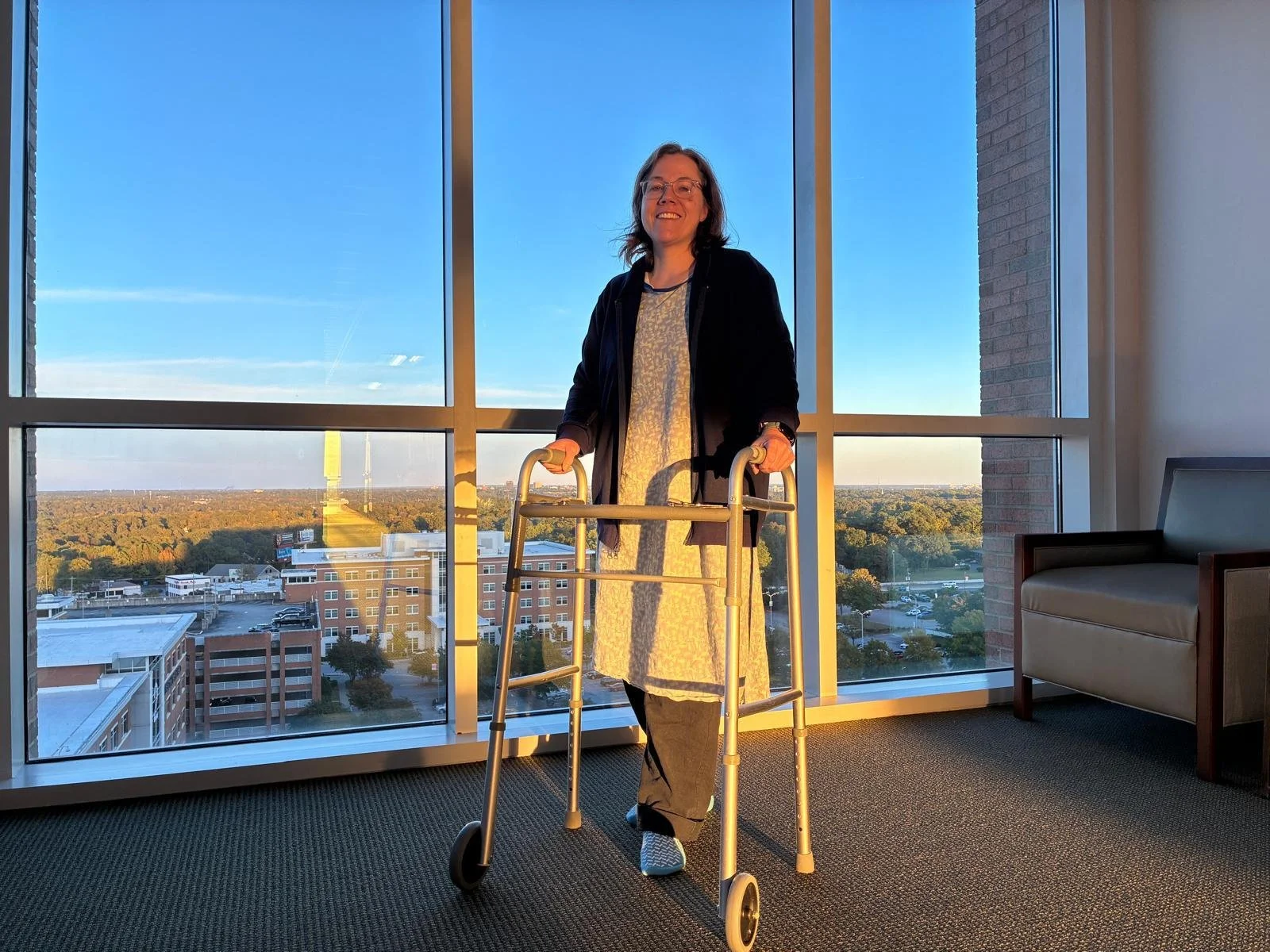
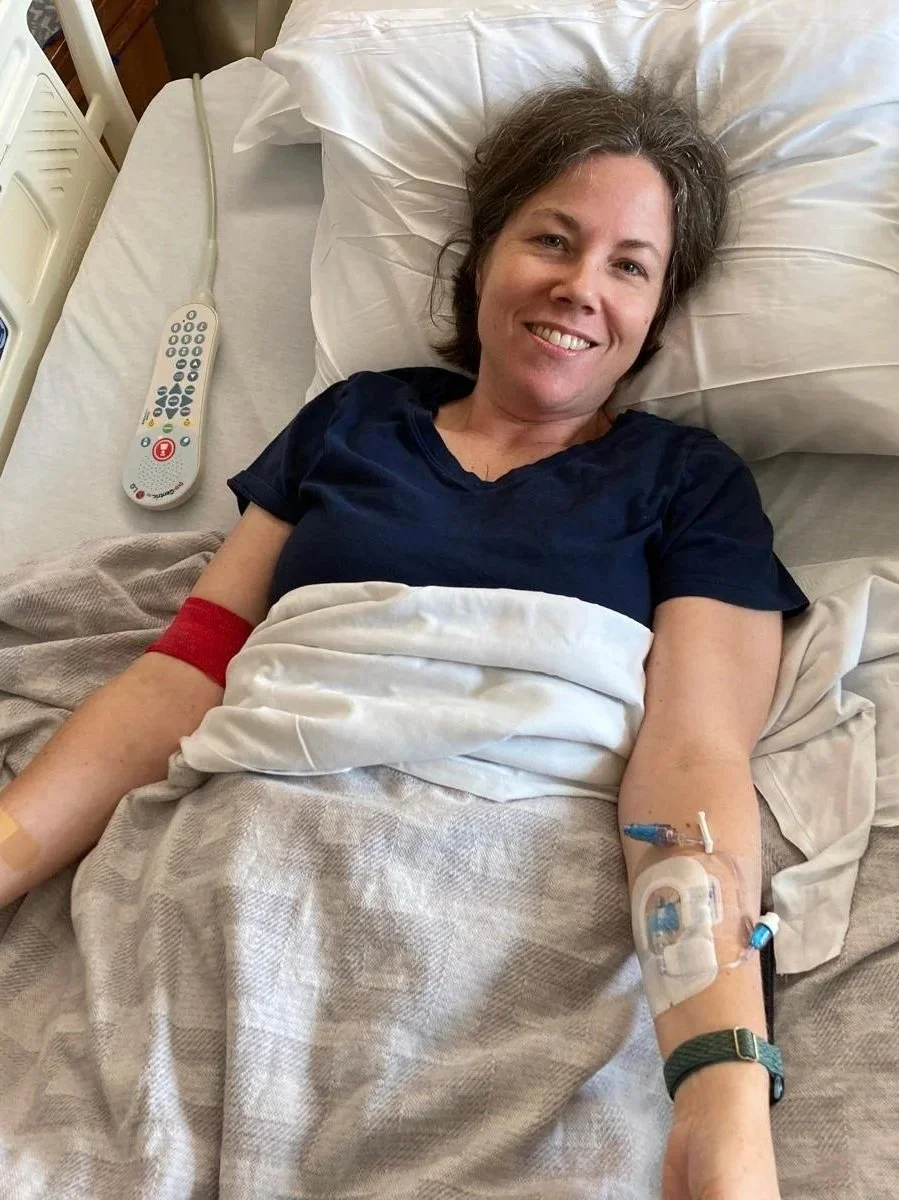
Gillian at the hospital.
TIME TO HEAL: The Next Battle
On schedule, I had another attack a month later. I’d added carbs back into my diet, so this one wasn’t as bad as May’s attack, but it was still bad. Another ten days in the hospital. I spent my 4th of July Independence Day getting a port inserted, and I watched fireworks from my ninth-floor hospital window.
I was still coordinating retreats for our organization, and a retreat coincided with my latest attack. My husband and I were supposed to be there to direct the retreat and help the team of volunteers in another state. Providentially, friends who brought their child over from England to participate in the retreat were able to direct it for us. The other volunteers stepped up to their roles, and the retreat was able to go on as planned. So thankful. But such a loss.
These attacks earned me weekly hemin treatments at the hematologist’s office and monthly Givlaari shots, the entire list of possible treatments.
THE BIGGER STORY
We can see very clearly how my diagnosis happened by providence, not coincidence. My gynecological issues led me to the hysterectomy, which led me to a hospitalization, which led me to an attack where my third GI was consulted, and he found the zebra unicorn because he did his residency three hours away where porphyria was treated. The extra tests and diagnoses along the way helped the diagnosis.
But even more than that, a 25-year-old mystery was solved.
Twenty-five years before my diagnosis, my mom, who suffered for years with a mystery illness, took her own life. At the time I was 22 years old and had been married for five months. My sister was 25, and my brother was 16. My dad was left shattered yet still had to be Dad.
Mom had been seriously ill on and off for about seven years. The doctors could not find a root cause. Some near to her doubted her symptoms were genuine illness. “It’s in your head,” they’d say.
Just a week before I turned 47, the very same age as my mom when she died, God gave me not just the gift of my own diagnosis, but also what was likely hers: Acute Intermittent Porphyria. By God’s grace, I get the gift of diagnosis and treatment she never had.
Her symptoms included tachycardia, urinary retention, gut pain, weakness, partial temporary paralysis, restless legs syndrome, and, by the end, bouts of likely psychosis. She was also on hormones for perimenopause, which are known triggers for AIP. But her doctors could not pinpoint the cause of her symptoms. In fact, for years we blamed addiction to her medications.
The piercing trauma of losing her was so sharp I wondered how air could flow through my lungs. I developed tremors and suffered abdominal pain that I muscled through with Xanax during her funeral. We now wonder if it was one of my earliest porphyria attacks.
Over the years the emotional gash of losing her has healed to a tender scar, no longer an open wound. I forgave her years ago, and then again and again since. She was so very ill, and she was no longer who she wanted to be by the time she died.
My love and forgiveness for her grew even more as I experienced new understanding of the suffering she must have faced. And I now understand the challenging mind game of not being believed.
My diagnosis, while a challenge, has been a gift of closure I didn’t know I needed.
I am so thankful for our mom, and I love and miss her deeply. She adored Justin, and she would have loved her future in-laws and grandchildren.
“My diagnosis, while a challenge, has been a gift of closure I didn’t know I needed. ”
LIVING IT OUT: It Takes a Village
My biggest thank you goes to my primary caregiver, my husband Justin. He’s gone above and beyond to understand my disease, how the hemin is run through the pumps, how to advocate for me when I’m incapacitated by an attack, and more. We both sometimes groan under the weight of this season and lament the challenges, but he has never complained. He just does what needs doing.
We are also so grateful for our sons and daughter in-love and close friends and family who show up for turns in the hospital and help in a thousand ways. We thank God for them and could not make it without their love and care.
I am grateful for every doctor who saw anxiety as a symptom, not a diagnosis.
I am thankful for my third GI’s creativity and willingness to look at the big picture beyond his specialty.
I am thankful for his team willing to back him up by figuring out tests and where to send me.
I am thankful for the people on the other end of all my portal messages. I know I have asked some off-the-wall things. I am so grateful for their patient responses.
We are so very thankful for the healthcare teams on the oncology floor of our local hospital and the oncology infusion clinic that care for me during attacks. They work so hard to get me the help I need quickly. The doctors, pharmacists, nurses, and techs. Oof. Every effort has been made for me, and I am so grateful.
A BIG THANK YOU to my brave local hematologist who took me on as her patient and to her team that does so much behind the scenes for me.
Dr. Bonkovsky is the bees knees for all he’s done for me and Porphyria research, and now Dr. Rudnick has taken up my case in Dr. B’s place.
I am also thankful to my family doctor, rheumatologist, and other specialists who all BELIEVED me and kept looking.
Above all, I am thankful to God. He worked out this timely diagnosis and a path to getting better.
It has been revealed, and now we will continue to pray for it to be healed.
Gillian’s inspiring story.
Want to share your story? Contact us at katri@porphyria.org
Meet others living with porphyria